This has been a rough week in carving out time to work, but I have been reviewing the research while thinking through some of the items I want to be sure to include/demonstrate in this course. I am currently concentrating on aesthetics.....
Aesthetics
I am a planner...and a list maker..... I need to make a list of items to be sure I include in the narrative and game design. so, I have been reading the research and our selected text.....and making lists.
Aesthetics encompass the various emotional goals of the
game: sensation (game as sense-pleasure), fantasy (game as
make-believe), narrative (game as drama), challenge (game as obstacle
course), fellowship (game as social framework), discovery (game as
uncharted territory), expression (game as self-discovery), and
submission (game as pastime) (Kim, 2015). Aesthetics, then, are the
result of how players follow the mechanics then generate the dynamics.
Playing games should be fun and appealing. Assuming that players will
stop playing if they do not enjoy themselves, then creating player
enjoyment should be the main goal (Robson, et al., 2015).
Van der Spek, Van Ostendorp,
and Meyer (2013) suggest integrating surprising events can stimulate
deeper learning and that a narrative background can decrease learning,
so game designers need to seriously consider how they embed instruction
in the game narrative. Amory (2007) proposes educational games should be
designed as narrative spaces where story and plot allow characters to
construct their own meaning through the use of
plot hooks, characters, backstory, and
cutscenes.
Plot hooks
are used at the beginning of a game to draw players into the game. A
plot hook can take several forms: an urgent plea for help, a central
character who awakes in a strange location, or a detective assigned to
solve a crime. Their purpose is to arouse curiosity and create intrigue. Good plot hooks put players into the middle of action without providing
much explanation, serving as an impetus for the player to begin the
game.
Our game will open with something similar to the following:
You have been
summoned to represent your guild at the Tower of a pair of mages on the
continent of Gamitopia. Why you were chosen and the reason behind the
gathering is unknown...but will reveal itself to you as the game
progresses…
This is a very
hazardous quest. You will travel in a small guild party although some
quests can only be completed alone. Your guild party will be based on
interests and skills so hopefully the avatars you choose will support
and complement one another, allowing you to overcome the many Challenges
you will face.
Are you ready to continue and learn more about what awaits?
If so, click on SUBMIT ASSIGNMENT, and in the text box, type the phrase, "I am ready to begin!"
Compelling
characters need
to be integrated throughout the game. In adventure games the player is
often cast as the protagonist. Providing information about the goals,
personality and motivations of the protagonist and other characters can
foster an emotional connection between the player and the main
character. This connection is established through the use of
multidimensional characters with both strengths and flaws (Freeman,
2003) and by having characters that change and grown throughout the game
(Rollings & Adams, 2003).
Hmmmmmm.... Perhaps I should add a Guide to lead them through their journey to the Tower and serve as a narrator. The Guide could introduce our travelers to a variety of other characters who could serve as specialists in the content provided in the various towns. Challenges (quizzes) could be presented by characters as well.... I just need to concentrate on developing character strengths and flaws to make them more interesting.
Backstory and
cutscenes deliver the narrative and help players to uncover the narrative story line.
Backstory
refers to the background, the history of the story line, and provides
dramatic context for the action. This could be as brief as a simple
sketch of the main character and key conflicts in the storyline or as
complex as providing detailed histories of all of the characters and
conflicts along with maps of the game world.
Cutscenes are short
pieces of narrative revealed during game play. They could take a variety
of forms: a radio broadcast, a telephone message, an email, a journal
entry, a newscast, or even a brief video.
Cutscenes provide players with key information, often appearing at the end of puzzles or challenges (Hancock, 2002). Examples of
cutscenes include flashbacks, parallel actions, foreshadowing, cliff hangers, and red herrings (Hancock, 2002; Onder, 2002).
This may take more planning....I will need to add some conflicts along the way to add some challenge...wonder if we could create a map, then have the map appear in between each city visit..... I may have to learn some java as it would be great to have little footprints appear to show the travelers where they have been... I really will need to work more on the
backstory and perhaps use flashback to help tell the story/narrative.....I already have a few
cutscenes developed but will need to develop more.
Fellowship..... we have discussed having team quests as well as individual quests, but discussion forums might be a useful tool. I wish Canvas had a course chatroom option, but I suppose we could set up one discussion thread to serve as a chatroom. Perhaps one quest could be to complete a task to be posted in a forum then a followup quest could be to critique one another's question post.....
Why ponder aesthetics now?
Keeping the aesthetics in mind as we design each city/town/village/hamlet will hopefully help us create a better and more engaging game, and, in this case, a better and more engaging course as we model the process. The assumption is that since this course is an elective, it will attract students who are interested in gamification and, thereby, more likely to immerse themselves in the game we offer. We have decided hat students will play our game for approximately 8 weeks, then work on their major project, then return to the game during the last week or two of the course. The thought is this way students will have a break from the game while they work individually, possibly increasing the likelihood of them finishing the class.
I feel the need to constantly remind myself of what to include as I design to keep myself from future massive redesigns. I will probably revisit this several times just to keep myself on task. When I look a Canvas for this week, I have done nothing...yet I have copious pen-and-notebook notes. Perhaps next week will move more quickly.
Action Plan
What's next for me?
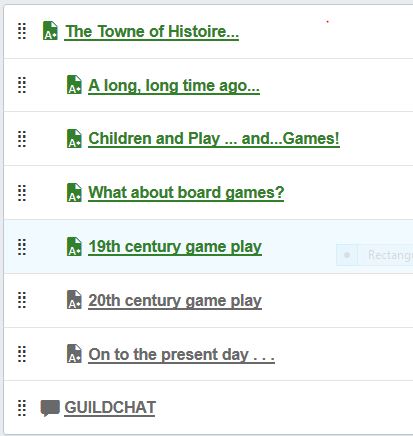
I want to finish re-reading our text, adding those notes to my notebook, then finish the first town of Histoire, making sure I include as many of the aesthetics as possible. Now that I know what I need to do, and have a list, development should move more quickly, then I can move on to another town.
References
Amory, A. (2007). Game object model version II: A theoretical framework for educational game development.
Educational Technology Research and
Development, 55, 51-57.
Freeman, D. E. (2003).
Creating emotion in games: The craft and art of emotioneering. Indianapolis, IN: New Riders.
Hancock,
H. (2002). Better game design through cutscenes. Retrieved July 27, 2015
from
http://www.gamasutra.com/view/feature/131410/better_game_design_through_.php
Kim, B. (2015, February/March). Game mechanics, dynamics, and aesthetics.
Library Technology Reports, 51(2), 17-19.
Onder, B. (2002). Storytelling in level-based game design. In F. D. Laramee (Ed.)
Game-design perspectives (pp. 291-298). Hingham, MA: Charles River Media.
Robson, K., Plangger, K., Kietzmann, J. H., McCarthy, I., & Pitt, L.
(2015, July). Is it all a game? Understanding the principles of
gamification.
Business Horizons, 58(4), 411-420
Rollings, A., & Adams, E. (2003).
Game design. Indianapolis, IN: New Riders.
Van der Spek, E, D., Van Ostendorp, H., & Meyer,, J. J. (2013).
Introducing surprising events can stimulate deep learning in a serious
game.
British Journal of Educational Technology,
44(1), 156-169.